
New Europe College
Romania

Jan ORT, Postdoctoral Researcher within the project Unequal Citizenship and Transnational Mobilisation of Polish, Czech and Ukrainian Roma in the Face of the War in Ukraine (ROCIT)
on Thursday, 10 December 2026, at 3 pm (Bucharest time), at New Europe College (Plantelor 21, Bucharest) & via Zoom
Zoom link
Meeting ID: 843 8269 4854
Passcode: 244476
Abstract:
Scholarship on Roma under state socialism has long understood violence primarily as the denial of cultural self-determination, and racism as the subtext of seemingly neutral assimilation policies. The subsequent turn towards Romani agency rightly freed Roma from the position of passive victims, yet it also pushed violence out of view. Racial violence, in turn, has been associated chiefly with the advent of capitalism after 1989. Race is increasingly debated in Central and Eastern Europe, where it was long overlooked and subsumed under ethnicity, but research on race under socialism still centres on state ideologies and top-down policies. This presentation brings violence back into focus through the lens of race and a localized empirical study. It examines the 1966 pogrom in Vlachovo, eastern Slovakia, after which the authorities resettled the village’s entire Romani population to Czechia. The author treats the pogrom not as an isolated outburst but as part of broader processes: the racialization of Roma, the state’s population policies and the shifting position of Roma within local socio-economic structures. Tracing the interplay between local processes and central policies, he argues that the violence drew on a “reasonable” anti-Roma racism, legitimized both locally and by the state, not least through benevolent violence, the conviction that removing Roma served their own good. This legitimization of the expulsion rested on a notion of Romani evictability shared by central policymakers and local actors alike.
Short bio:
Jan Ort is currently a postdoctoral researcher with the ROCIT project, which focuses on the consequences of the war in Ukraine for Roma in Central and Eastern Europe. His research tracks the experiences of Ukrainian Roma refugees and the activities of Roma elsewhere who mobilised to support them in a situation of institutional racism. More broadly, he is interested in how the war-related situation changes and challenges dominant understandings of the position of Roma in predominantly non-Romani societies.
Trained in Romani Studies, he conducts research among Roma in different European countries, drawing on a variety of disciplines, notably anthropology, history and sociolinguistics. His long-term ethnographic research in eastern Slovakia focuses on everyday interethnic relations and Romani strategies of sociability, themes he explores in his first book, Facets of a Harmony (2022). In his PhD research, he turned to history, examining the experiences and life strategies of Roma in the context of the resettlement programme carried out in socialist Czechoslovakia in the 1960s. His dissertation was published as Roma as Agents of the “G*psy Question” (2024).
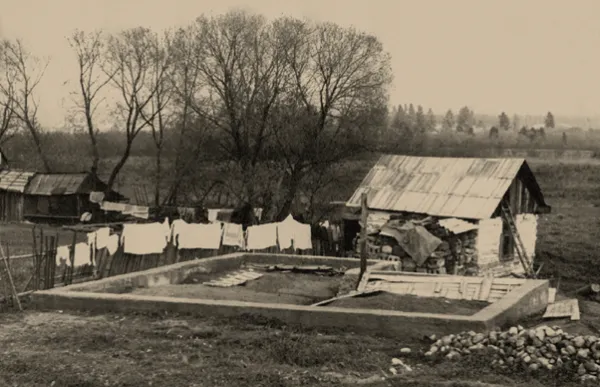
Photo source: State Regional Archive in Košice, Slovakia, 1965
*
This event is organized within the framework of The Group for Anthropological Research and Debates (GARD) hosted by New Europe College.