
Institut d'études avancées de Nantes
France

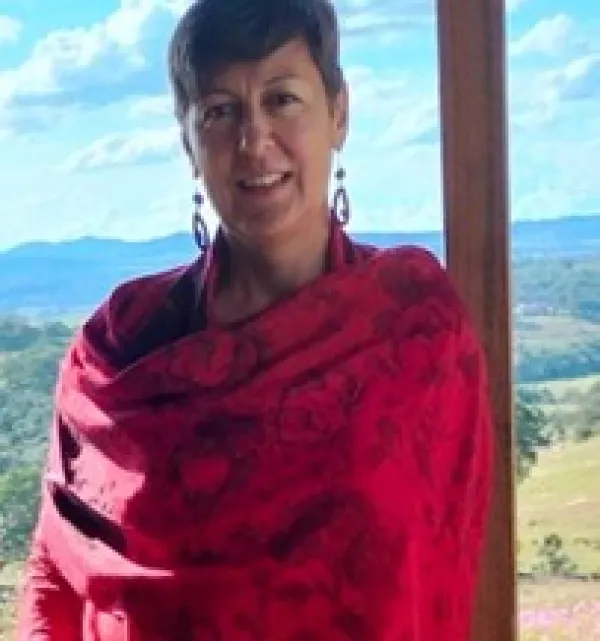
Claudia Rosina Bara is a university professor and researcher at the Faculty of Accounting and Administration of the Autonomous University of Querétaro (UAQ), on the Amealco de Bonfil campus, a rural and Indigenous region in the state of Querétaro, Mexico. A German national born in Romania, her academic and professional path is marked by a rich diversity of intercultural experiences in Spain, France, Egypt, Canada, Ecuador, and Mexico, where she has lived for fifteen years.
She holds a PhD in Environmental Sciences obtained in Mexico and has also received training in agroecology and international trade in Spain and Germany. Her academic and professional trajectory has led her to develop research and social engagement projects in Mexico focused on agroecology, alternative food networks, and food sovereignty.
She currently lives at the Ar Däzu eco-ranch, located in a rural Indigenous area of the state of Querétaro. This autonomous project embodies sustainable management of water, energy, and food resources, reflecting her commitment to ecological and solidarity-based ways of living.
This collective project examines how food can be understood and managed as a commons — a shared resource that is collectively governed and goes beyond the constraints of private property or commodification.
Grounded in the values of solidarity, cooperation, and collective governance, the multidisciplinary team proposes to study how communities in Mexico and in certain regions of Europe organize their food systems in ways that integrate ecological sustainability, health, and livelihoods, while fostering interdependence and reciprocity.
By exploring the roles of education and gender in sustaining these practices, the project also investigates how responsibilities are equitably distributed within communities.
As part of this initiative, the project team will organize an international roundtable bringing together practitioners, organizations, and scholars to discuss the challenges and opportunities involved in scaling up commons-based food practices. This dialogue aims to address issues of governance, inclusivity, and the sustainability of food systems, while generating concrete pathways for applied research.
The ultimate goal is to launch an applied research project following the residency, focusing on adapting and implementing proven models of food commons in diverse contexts. This forward-looking approach combines theoretical reflection with practical strategies, thus contributing to the global debate on the commons as a foundation for more equitable and resilient systems.
Environmental science