
Institut d'études avancées de Paris
France

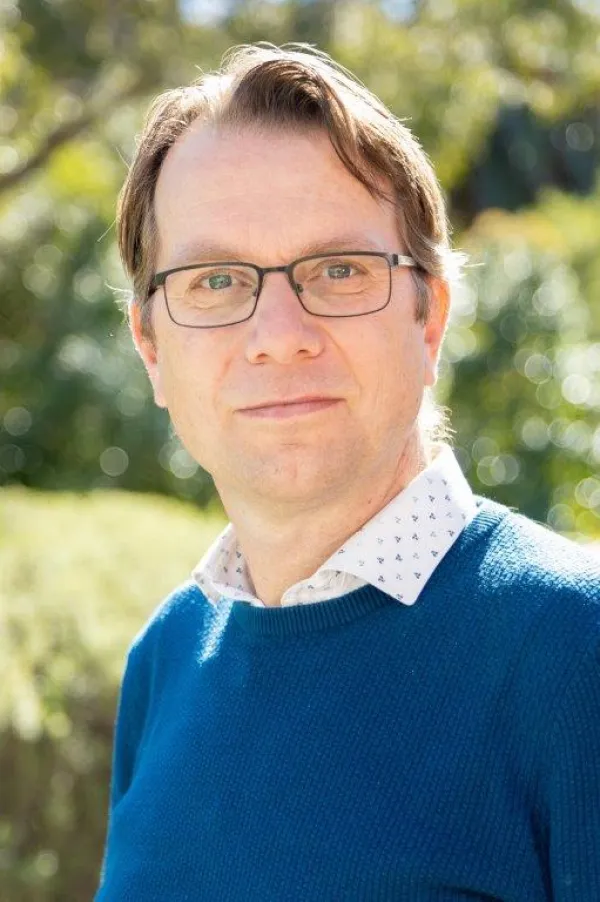
Bram Büscher is Professor and Chair of the Sociology of Development and Change group at Wageningen University in the Netherlands and visiting professor at the University of Johannesburg in South Africa. Bram Büscher’s research investigates changing human-nature relations and environment-development interactions in and beyond the context of late capitalism.
His broader intellectual project seeks to bring human-nonhuman relations and biodiversity conservation deeper into our understanding of the trajectories of global capitalism while imagining post-growth convivial ways forward. He is the author of The Truth About Nature. Environmentalism in the Era of Post-Truth Politics and Platform Capitalism (University of California Press, 2021) and co-author, with Robert Fletcher, of The Conservation Revolution: Radical Ideas for Saving Nature Beyond the Anthropocene (Verso, 2020). In 2021, Bram Büscher held a fellowship at the Stellenbosch Institute for Advanced Study.
In September 2026, he joined the Paris IAS for a ten-month residency as part of the FIAS (French Institutes for Advanced Study) international mobility program – funded by the European Union’s Horizon Europe program under the Marie Skłodowska-Curie Actions (GA-101217263).
The planet is currently witnessing a sixth mass extinction event. Given its importance, species extinction is receiving increasing, though fragmented, scholarly attention. Startlingly absent is research that brings together the manifold environmental and social dimensions of the extinction crisis, especially extinction’s multidimensional unevenness across time and space and how this is related to changing forms of capitalist development. This is important since species decline is often depicted as a linear process that straightforwardly mirrors capitalist development patterns. In reality, however, capitalist development and biological diversity influence, shape and transform each other in myriad, highly uneven ways that are ill understood and rarely theorized.
French actors, science and history are central to these transformations and how they have shaped contemporary meanings of both biodiversity and capitalist development. The project will investigate the historical dimensions of these transformations, particularly the foundational influence of key figures like Comte de Buffon, Jean-Baptiste de Lamarck and George Cuvier and institutes like the Muséum National d’Histoire Naturelle, as well as more recent and contemporary French actors, ideas and institutions. This will feed into a more holistic understanding of the changing relations between biodiversity and capitalist development and their implications for human-nature relations in an age of extinction.
Environment; Conservation; Development; Biodiversity; Political Economy.