
Swedish Collegium for Advanced Study
Sweden

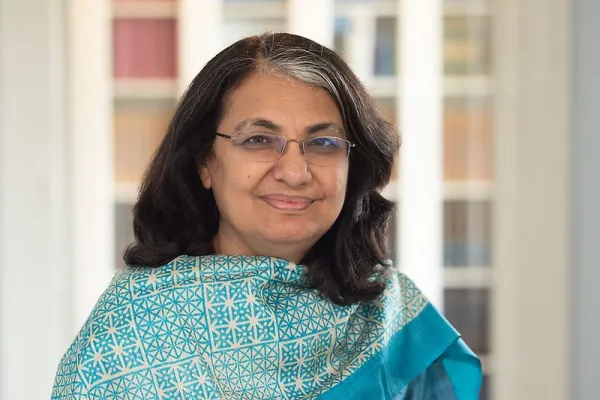
Navnita Chadha Behera has been a Professor of International Relations at the Department of Political Science at the University of Delhi since 2009. She has held visiting professorships and fellowships at various universities and think tanks, including George Washington University, University of Warsaw, Uppsala University, University of Bologna, Central European University, University of Illinois Urbana-Champaign and the Brookings Institution. She also served as the Vice-President of the International Studies Association (2019–2020).
Behera’s work and publications focus on genealogies of the discipline of International Relations and on pluralizing the sites and sources of its domain knowledge, including its pedagogical practices. She has authored, edited and co-edited nearly a dozen books including India Engages the World (Oxford University Press), International Relations in South Asia: Search for an Alternative Paradigm (Sage), and Demystifying Kashmir (Brookings Press). Her research has also been published in several international journals, including International Affairs, International Studies Perspectives, Security Dialogue, International Relations of the Asia-Pacific and Democratic Theory. Among her most recent publications is a co-edited special issue of Review of International Studies, on ‘Pluriversal Relationality’.
While at SCAS, she will work on her book project, which addresses a fundamental disconnect between the key knowledge categories propounded by conflict and peace researchers and the lived realities of people experiencing those conflicts. Drawing on ethnographic and archival research, the project seeks to explore how vernacular registers of thinking, speaking and practising existence can serve as legitimate sites of knowledge production.
International relations theory; practices and politics; knowledge production; pluriversal relationality; critical pedagogies in IR; conflict; political violence; South Asia/India; Kashmir conflict