
Collegium Helveticum
Switzerland

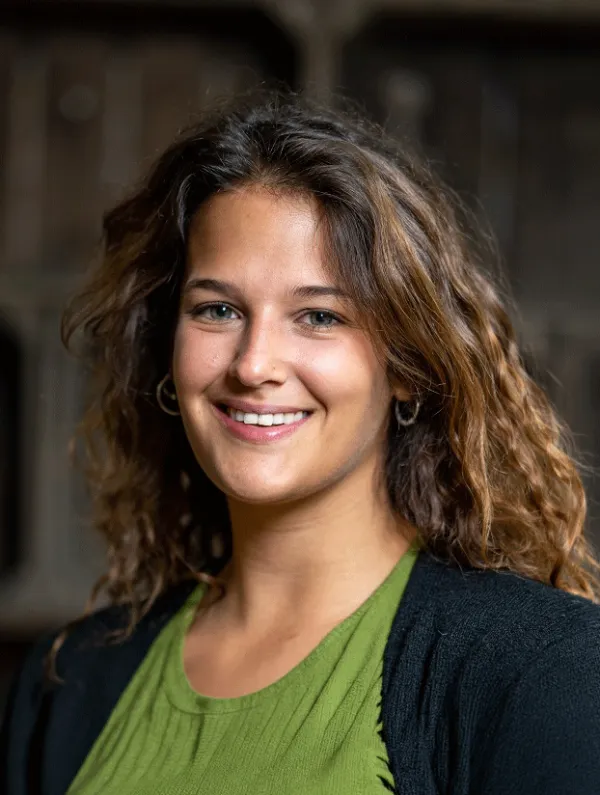
Fabiola Diana (born 1993 in Turin, Italy) is a social neuroscientist interested in how the social brain evolved to navigate both human-human and human-robot interaction. Her interdisciplinary work combines multimodal psychophysiology with naturalistic settings to study how the human social and moral system responds to humans, as well as to partners it never evolved to meet, such as artificial agents. At the Collegium, she will study the neural, physiological, and behavioral dynamics of moral decision-making, examining whether these dynamics extend to interactions with artificial entities, and deepening the philosophical and ethical dimensions of these questions.
Fabiola received her PhD from Leiden University (NL) in 2026, where she investigated how interpersonal alignment shapes moral behavior in interactions with humans and artificial agents. Before joining the Collegium, she held a postdoctoral position at Utrecht University (NL). Fabiola's research spans different fields, integrating approaches from social neuroscience, human-robot interaction, and evolutionary biology. For this interdisciplinary approach, she was awarded the Human-Robot Interaction Pioneer Award in 2025.
As artificial agents become companions and collaborators, this project asks whether the moral instincts we evolved for human relationships extend to machines.
Where do our moral obligations begin and end? Across history, cultures have extended moral consideration beyond humans, to animals, landscapes, and invisible agents, embedding these norms in rituals and taboos. Today, artificial agents pose a new version of this old question: neither alive nor passive, yet designed to interact with us and respond to our behavior. Is it then acceptable to lie to a virtual assistant, or be rude to a chatbot?
Moral decisions are rarely purely rational. We often rely on rapid, gut-level judgments shaped by the body itself: its neural processes, physiological states, and expressions. Yet research on moral behavior remains fragmented, studying brain, body, and behavior separately rather than as one system.
This matters more as artificial agents increasingly populate our lives as companions and collaborators. Does the moral architecture that evolved for human relationships extend to machines? This project asks whether moral decisions unfold through consistent brain-body-behavior dynamics, and whether these dynamics hold, weaken, or reorganize when directed toward artificial entities–in dialogue with philosophical and anthropological perspectives on acting (im)morally in an artificial world.
artificial agents; moral; human relationships; obligations