
Institute for Advanced Study at Central European University
Hungary

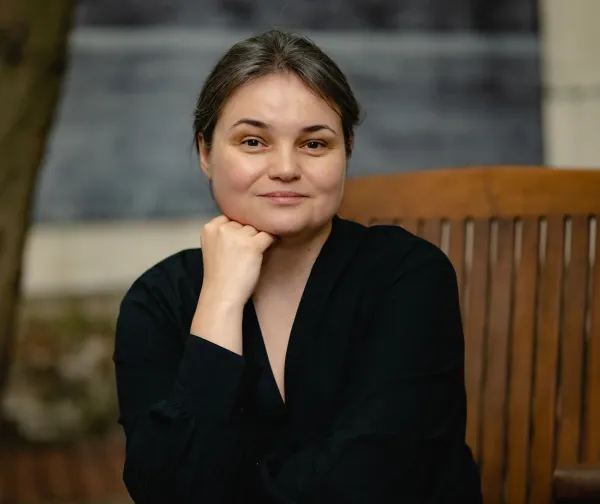
Sofia Dyak is Director of the Center for Urban History in Lviv, Ukraine. She holds a BA in history from the Ivan Franko National University of Lviv, an MA in history from the Central European University in Budapest, and a PhD in sociology from the Institute of Philosophy and Sociology of the Polish Academy of Sciences (Warsaw). Her dissertation "Re)imagined Cityscapes: Lviv and Wrocław after the Second World War" compared the postwar history of integration of two Central European cities, Lwów/Lviv and Breslau/Wrocław.
Dr. Dyak was a fellow of the German Historical Institute in Warsaw, the Gerda Henkel Foundation, the Institute for Human Sciences in Vienna, the Historical Dialogue and Accountability Program at the Institute for the Study of Human Rights of Columbia University, and the Harvard Ukrainian Research Institute. In 2019-2023, she was a senior research fellow at the Center for Contemporary History in Potsdam. In 2021, she joined the Board of Directors of the Ukrainian-Jewish Encounter initiative.
Our project, a co-authored book by Sofia Dyak and Mayhill Fowler, is A Concise History of Ukraine. The book aims for a fresh approach to the history of Ukraine, moving decisively beyond the national paradigm that has dominated historiography since the 19th century. Rather than telling the story of Ukrainians, the book explores Ukraine as a place: a dynamic constellation of connections, layers, and accumulated meanings that resist reduction to any single national narrative. We develop this method in three ways: following people and peoples across time and territory, tracing multiple centers, peripheries, and connections between them, and weaving different, often-competing historiographic threads. The result is a history not of one stateless people striving towards nationhood, but of many colliding states and state projects, peoples and communities, ideas and objects. A Concise History of Ukraine offers a kaleidoscopic view of elements that scholarship has generally examined and presented in isolation, but which, when woven together, illuminate Ukraine in a richer way, honoring its complexity and its indispensable place in the larger European story.
post-war urban recovery; public history; Ukraine