
Collegium Helveticum
Switzerland

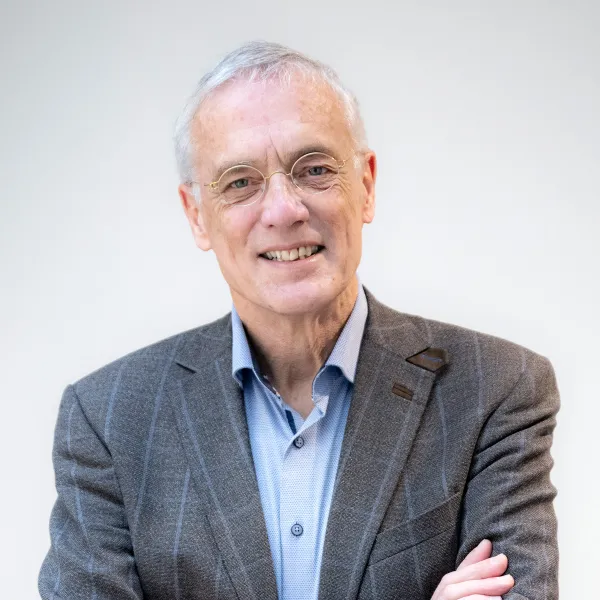
Huib Ernste (born 1957 in Doorn, NL) is a Professor for Human Geography at Radboud University Nijmegen (NL). His academic research focuses on (critical) social theories and qualitative and quantitative research methodologies in human geography. Starting with action theoretic approaches, he extended his interests in relational approaches, e.g. actor network theory, assemblage theory, complexity theory and practice theories, while at the same time focusing on the human agent in relation to places from the philosophical anthropological perspective of Helmuth Plessner. Currently, he investigates the affective relationship between human beings and urban places, from the neo-phenomenological perspective of Hermann Schmitz and Gernot Böhme.
Huib received his MSc. from the University of Groningen (NL) and his PhD from ETH Zurich (CH). Before joining the Collegium, he was an associate professor at ETH Zurich and held guest professorships at the University of Utrecht (NL), University of Salzburg (AT), UCLA Los Angeles (USA) and University of Münster (DE) after which he was chairing the Geography Department of the Radboud University Nijmegen (NL) for more than twenty-five years.
By comparing urban places Huib empirically uncovered the way affection for specific places is emerging and created. This allows the fine-tuning of the conceptualization of these “feelings” and “affections” suggested by the neo-phenomenological perspective and the exploration of possibilities to design places in such a way that they are effectively experienced as more pleasant, just, and effective. This topic is closely related to the work of architects, urban designers, urban planners, and (art) curators of events and places as well as of social psychologists, sociologists, and philosophers.
This research topic is currently intensively debated in these disciplines and is closely linked to the increased attention given to the forgotten dimension of ‘emotions’ in our current society. Emotions and “experiences” are no longer seen as a rather irrelevant irrational ‘rest’ factor, but increasingly as the basis and driving force behind our (spatial) choices, behaviour and “performance.”
Instead of reducing this topic to only the affective dimension, through this research, Huib tried to grasp the full relational complexity of the way we experience, create, and perform or practice (urban) places.
urban places; emotions; experiences; neo-phenomenological perspective