
Collegium Helveticum
Switzerland

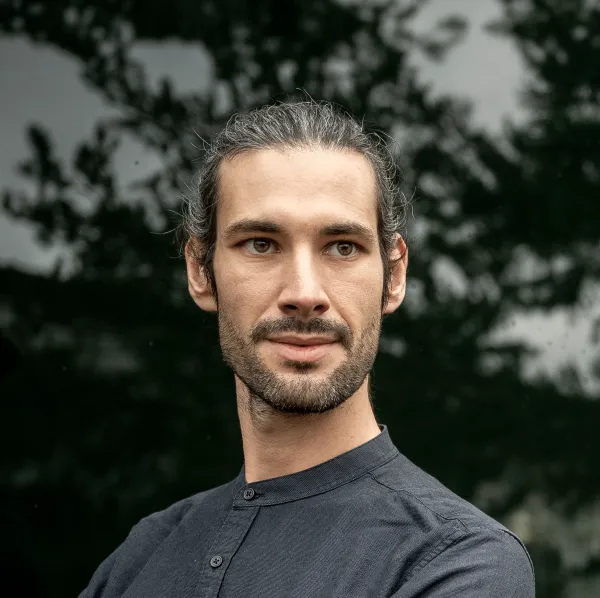
Matteo Fadel is a quantum physicist working on controlling mechanical vibrations in the quantum regime. His research explores how phonons, the elementary units of sound, can be generated, controlled, and measured at the quantum level using superconducting circuits. By developing new methods to control quantum states of motion in solid-state devices, his results have applications in both quantum technologies and experimental tests of the foundations of quantum mechanics.
Matteo began studying physics at the University of Padova (IT), followed by a master's degree at ETH Zurich (CH). He completed his PhD in Basel (CH), where he investigated multipartite quantum correlations in Bose-Einstein condensates. Motivated by an interest in exploring quantum effects in macroscopic objects, as well as a passion for experimental music, he joined the HyQu group as a Branco Weiss and SNSF Ambizione Fellow, with the goal of manipulating sound at the quantum level to explore the boundaries of quantum mechanics.
Quantum mechanics is extraordinarily successful at describing microscopic systems, yet it does not specify a scale at which quantum behavior should disappear. Matteo’s project investigates this boundary using mechanical oscillators that can be prepared and controlled in quantum states of motion.
The aim is to create and sustain increasingly large quantum superpositions, namely situations in which a system exists in multiple states at the same time—real-world analogues of Schrödinger’s famous thought experiment, in which a cat is imagined to be simultaneously dead and alive—and to use them to probe how quantum behavior persists in increasingly massive and complex systems. These experiments may help clarify the transition between quantum and classical physics and, given the relatively large masses of mechanical oscillators, such as a vibrating membrane or crystal, could also shed light on possible connections between quantum mechanics and gravity. Indeed, one of the fundamental open questions at the interface of these two theories is what gravitational field is generated by a mass placed in a quantum superposition of being in two different locations at once. Exploring this question could provide new insights into whether gravity itself must be described within a quantum framework, or whether a more fundamental theory of nature does not involve the quantization of the gravitational field.
Beyond their scientific significance, such experiments raise profound questions about the nature of reality, the limits of classical intuitions, and the role of observation in defining physical phenomena. Moreover, they also invite reflection on the impact of new quantum technologies that will change our capabilities to perform computations, communication, and measurements. At the Collegium, Matteo will place these questions in a broader interdisciplinary context, engaging with philosophy, technology, and society to explore how macroscopic quantum phenomena can challenge our understanding of reality and impact our everyday lives.
quantum mechanics; microscopic systems; Schrödinger