Collegium Helveticum
Switzerland
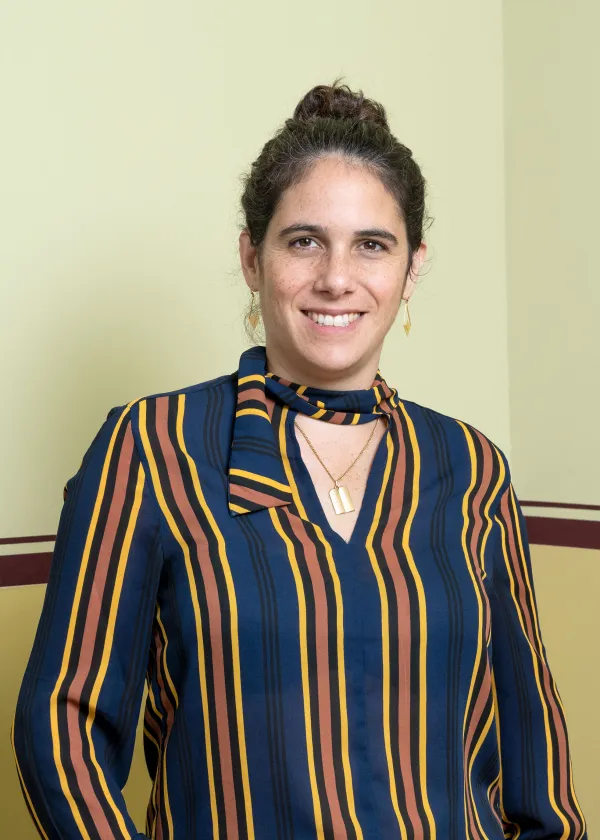
Liat Grayver (born 1986 in Kfar Yehezkel, Israel) is a cross-disciplinary painter and media artist. She investigates methods to redefine one of the most primordial forms of art—painting—within the current technology-based era. Since 2016, Liat has been collaborating with the University of Konstanz on the development of the e-David painting robot, thereby exploring various approaches to integrate robotic and computer languages into the processes of painting and creative image-making.
Liat’s work has been exhibited at various international museums, galleries, and institutions. Since July 2023, Liat has been the artistic researcher and artistic director of the project EACVA: Embodied Agents in Contemporary Visual Art. The project, led by teams at Goldsmiths University and Konstanz University, was made possible by a grant from the German Research Foundation (DFG) and the Arts and Humanities Research Council (AHRC). The multi-disciplinary team of artists, computer art and robotics engineers, philosophers, sociologists, and psychologists approaches questions that are central in the field of human-machine interaction, art, aesthetics, and creativity.
Grayver studied at the Academy of Fine Arts Leipzig (HGB), where she completed her doctoral studies (Meisterschülerin) in media art under Joachim Blank in 2018. Her academic education has been complemented by a range of private studies and courses, including consultations with Neo Rauch (Leipzig, Germany), the Shiboku Studio for Japanese calligraphy (Haifa, Israel) and the Jerusalem Studio School of Painting and Drawing (Israel). She has attended several artist residencies, among them at the Centre of Excellence of the University of Konstanz (Germany), at Casa Paganini – Infomus in Genova (Italy), at MIT in Cambridge (USA), and at the Art Students League in New York City(USA). Liat is also an active member of SALOON — Network for Women of Berlin’s Art Scene.
Based on the history of the Semper Observatory, this exhibition explores the human fascination with the creation of meaning from patterns such as the constellations of stars and planets and, today, from all kinds of extracted data. Today’s methods that help in recognizing patterns include a diverse range of artificial intelligence algorithms and applications, often used for predictions and prognostics. The exhibition brings together scientists, academics, and artists who react to, reflect on, and work with these methods.
When we look back in time, one could say that the move to predictions and prognostics from the earlier practice of prophecies is really
just a matter of dimension and scale. Because, even if the religious beliefs faced by Copernicus and Galileo in the 15th to 17th Centuries seem to stand in harsh contrast to the scientific research being done today, these fields can be understood as two positions on a continuum, ranging from reading prophecies in the sky and mystical approaches to making predictions using computational power.
In fact, this past is still present today. Not only do parascientists and esoterics use early religious mystical texts in which astronomical
and mathematical patterns are embedded, but scientific researchers
also examine these texts as early forms of computational writing,
i.e. as codes and algorithms. What is more, when we move to the specialized field of computer science research into machine learning which relies on human intelligence and the brain as a reference for creating what we now call artificial intelligence—both scientists and engineers sometimes understand only the input and the output of these deep learning artificial neural networks. That is why this area of research is often considered a black box and—harking back to the older practices again—referred to as “Data Alchemy.”
The openness of today’s scientists and engineers towards different ways of understanding the world, seems to be closing the gap between science and art, mysticism, and other systems. Connecting code to cosmology and scaling from predictions and prognosis to prophecies links us to more holistic and plural modes of knowledge creation. And it may ultimately lead us to a terrestrial understanding of humans as a part of the biosphere on this planet.
The exhibition and the accompanying events are part of the Zurich Art Weekend 2023 program. During three days, from June 8 to June 11, the Zurich Art Weekend aims to facilitate access to culture and shed new light on the art scene of Zurich.
Patterns, predictions and AI; Science; Art, technology and holistic knowledge