
Collegium Helveticum
Switzerland

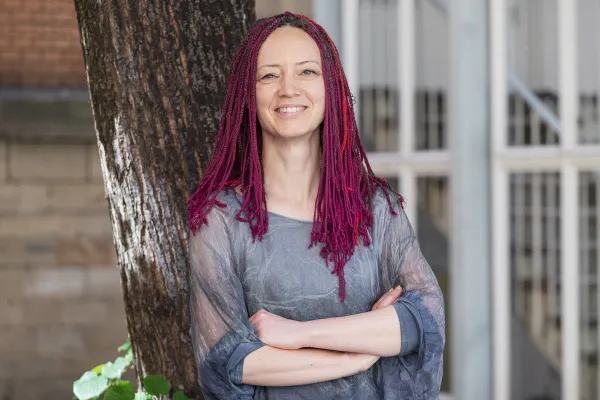
In 2009, Inge Hinterwaldner received her PhD in art history from the University of Basel, Switzerland, with a thesis on interactive computer simulations, resulting in the book The Systemic Image, originally published in German by Fink in 2010 and in English by MIT Press in 2017. Fellowships and grants allowed her to pursue her research at MECS in Lüneburg in 2014, at Duke University in Durham in 2015, and at MIT in Cambridge/MA in 2016. From 2016 to 2018, she was professor for modern and contemporary art in the Department of Art and Visual History at the Humboldt University in Berlin. Since October 2018, Inge has held a professorship for art history at the Karlsruhe Institute of Technology, Germany.
Her research focuses on interactivity and temporality in the arts, computer-based art and architecture, tectonics of programmed art, model theory, expressiveness of fluid dynamics, and the interdependence between the arts and the sciences since the 19th century. She is PI of the research group Coded Secrets: Artistic Interventions Hidden in the Digital Fabric, which deals with net-based artworks from a variety of perspectives and disciplines such as art, art history, computer science, media informatics, digital conservation, and visual cultural studies.
Programmed digital online art poses serious challenges for critical analysis. Complex linking structures, coded behaviours, and anchors in diverse internet strata are dimensions that easily lay beyond any intuitive registration. New methodological paths, as well as modes of communication, seem opportune to complement insights from phenomenological dimensions with those about what is somehow occluded, withdrawn, and in need of a conceptualisation from a humanities perspective.
Heath Bunting’s early iconic work of networked art, Visitor’s Guide to London from 1995, serves as a case study for theoretical and methodological conceptualizations. To grasp the tectonics of the work, Inge Hinterwaldner developsspecific aids such as visualisations and explanatory models. Modeling in the humanities is usually done through the elaboration of concepts, and less often through vivid three- or four-dimensional configurations to touch. Inge will systematically explore which types of corresponding hands-on models exist in the humanities in order to be able to classify and critically reflect on her own approach. This will also be done with recourse to disciplines in which modeling is already a long-established practice.
digital art; critical analysis