
Netherlands Institute for Advanced Study in the Humanities and Social Sciences
Netherlands

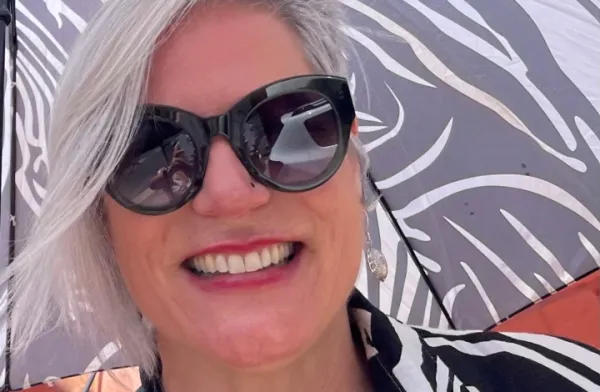
Susan Holland-Muter died before her arrival at NIAS. We are deeply saddened by her passing. († 2025 )
In Loving Memory of Susan Holland-Muter
It is with heavy hearts that we mark the sudden passing of Susan Holland-Muter — feminist scholar, activist, lesbian, and deeply beloved comrade in both academic and queer activist circles across South Africa.
Susan was never just a thinker — she was a builder, a disruptor, a weaver of care. She was also one of those rare white lesbian feminists who was deeply conscious of her own positionality and privilege, and whose praxis reflected that consciousness with humility and integrity — especially in a context where Black lesbian and trans women continue to bear the brunt of structural and intimate violence.
Though Triangle Project's formal collaboration with her was last in 2016, Susan kept showing up — in activist meetings, in feminist dialogues, in random unplanned restaurant sightings, and in those huge, unforgettable hugs. Some of us still smile when remembering her ever-enthusiastic pitches about “erotic justice” and those moments she’d burst out laughing at terms like “digital sex” — cheekily clarifying, "you know, finger fucking." She had that rare gift: to hold the political and the playful, the serious and the irreverent, all in one breath.
Her written work — including her contributions to Queering Cape Town and her bold call in Outside the Safety Zone: An Agenda for Research on Violence Against Lesbian and Nonconforming Women in South Africa — continues to resonate in our movements. Susan reminded us that our politics must stay rooted in lived realities — in bodies, in desires, in grief, in joy. She challenged us to think critically, to feel deeply, and to never lose sight of love and laughter as a radical force.
To Solange, and all of Susan’s loved ones — we hold you in our hearts and in our shared grief.
Susan Holland-Muter had envisioned an investigation into how the impact of anti-gender movements is experienced in the granular, everyday lives of womxn. Her proposed study aimed to explore Brazilian and South African womxn’s forms of everyday resistance by identifying and analyzing the different modes and meanings they attach to embodying the category of “unruly womxn.” These embodiments were to be examined across three interrelated sites: the body, the community, and the nation.
Holland-Muter intended to explore how these modes and meanings are (re)produced through the counter-narratives of “unruly womxn” to hegemonic gender and sexual discourses—forming assemblages of unruly thoughts, practices, and discourses that challenge and traverse national boundaries.
Her methodology included conducting semi-structured interviews with ten womxn each in Recife and Cape Town, as well as ten participants from Brazilian and South African communities in Amsterdam. These interviews were to include talking to their selected photographs, objects, and memorabilia—representations of the participants’ “unruliness.”
Susan Holland-Muter passed away before she had the opportunity to begin her NIAS Fellowship. Her research team are grateful for the donation NIAS has made towards continuing Susan’s project, navigating Susan’s theoretical and analytical field in her spirit.
Anti-gender movements and everyday resistance; embodiment and unruliness; transnational feminist networks; comparative gender studies Brazil-South Africa; counter-hegemonic narratives