Centre for Advanced Study Sofia
Bulgaria

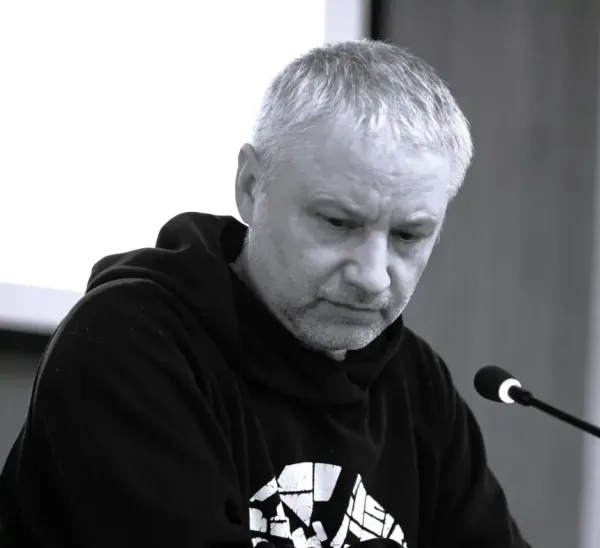
Mykola Homanyuk, sociologist, geographer and theatermaker, is an associate professor at Kherson State University. He graduated from Kherson State Pedagogical Institute and defended his PhD thesis in sociology at V.N. Karazin Kharkiv National University. He has held a Lane Kirkland Fellowship at Maria Curie-Skłodowska University in Lublin, a fellowship at the Indiana University-Ukraine Nonresidential Scholars Program, and a fellowship at the Petro Jacyk Non-Resident Scholars Program at the University of Toronto. Since 2022, he has been a Prisma Ukraïna: War, Migration, and Memory research group member at Forum Transregionale Studien. Mykola is the author of numerous articles on ethnic studies, mental mapping and toponymy, as well as memory and commemoration. He recently finished his book Monuments and Territory: War Memorials in Russian-Occupied Ukraine (with Mischa Gabowitsch), published by CEU Press. He runs the Kherson Theatre Lab as a theatermaker and directs documentary theatre productions. In 2018, he was awarded the ADAMI Media Prize for Cultural Diversity in Eastern Europe, and the Journalism Excellence Award by the Council of Europe in 2025.
What are the effects of the full-scale war on the relation between feelings of belonging to the Ukrainian political nation and to one’s own ethnic community? In this research, I am chiefly interested in identity transformations of ethnic minorities as a result of external shock. An important factor in my qualitative research is the role of the kin-state, and to what extent ethnic minorities’ political identities are shaped by the presence or absence of kin-state politics. Thus, to account for the role of kin-state politics, I want to focus on two border regions of Ukraine, which feature varying degrees of cross-border exchange between neighbouring states, their ethnic kin in Ukraine, and the Ukrainian state: Zakarpattia and Odesa Oblasts. Specifically, the Hungarian minority in Zakarpattia, and the Moldovan/Romanian in Odesa. In addition, two ethnic minority groups without a kin-state will be analysed in my study for comparison - the Roma and the Crimean Tatars. First evidence suggests that the well-established Hungarian and Romanian minorities, which both feature civil society networks and organisations, facilitated cross-border communication and assistance in aid delivery by the kin-state. As the full-scale war enters its fourth year, it is worth investigating these processes to discern whether this engagement has contributed to the long-term consolidation of a civic identity among minorities.
Ukrainian political nation; ethnic minorities; kin-state politics; identity transformation; Zakarpattia and Odesa regions; civic identity consolidation