Centre for Advanced Study Sofia
Bulgaria

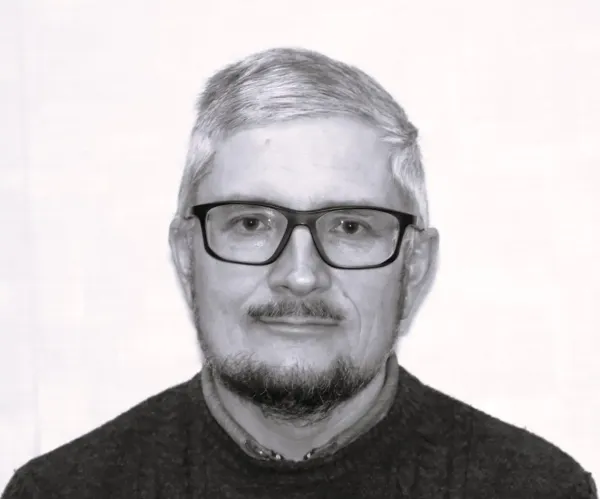
Dr. Roman Kyselov began his academic career as a historian of the Ukrainian language. This phase concluded with the defense of the doctoral thesis “The Lexicon of the Ukrainian Language in the Publications of the Pochaiv Printing House from the 18th–the First Third of the 19th Century” (2005). He has also contributed to research on the history of Cyrillic book printing and has co-authored several scholarly catalogues of early printed Cyrillic books. From 2006 to the present, he has been working at the Shevchenko Institute of Literature of the National Academy of Sciences of Ukraine. His current research focuses on Baroque oratory in early modern Ukraine and the rhetoric courses taught at the Kyiv-Mohyla Academy in the 17th and 18th centuries. During the 2024–2025 academic year, he was a research fellow at the New Europe College – Institute for Advanced Studies (Bucharest, Romania) within the IWM for Ukrainian Scholars program, exploring perceptions of the author’s role and views on plagiarism in early modern Europe. In April–May 2026, he was awarded the “Month in Poland” scholarship from the Juliusz Mieroszewski Centre (Warsaw, Poland), which enabled him to discover previously unknown copies of 17th- and 18th-century Kyiv-Mohyla philological courses in Polish collections. Dr. Roman Kyselov also works as a translator into Ukrainian, specializing in texts of early Ukrainian literature written in Church Slavonic, Old Polish, and Latin.
The project titled “The Languages of Early Modern Ukrainian Oratory (Based on 17th–18th-Century Rhetoric Courses at the Kyiv-Mohyla Academy)” explores the multilingual character of oratorical practice in early modern Ukraine through 17th–18th-century rhetoric courses taught at the Kyiv-Mohyla Academy. Drawing on manuscript student notes, it examines the use and interaction of Latin, Polish, Church Slavonic, Ukrainian, and their hybrid forms in educational and literary practice.
The study aims to identify the factors influencing language choice in oratorical texts, focusing in particular on genre and target audience. It traces the evolution of linguistic preferences over time and analyzes competing theoretical views on language use expressed by instructors. Special attention is given to macaronic Polish-Latin discourse, the emergence of Church Slavonic orations, and the limited role of the Ukrainian (Ruthenian) literary language.
Combining methods from literary history, textual criticism, historical linguistics, and sociolinguistics, the project seeks to reconstruct the linguistic landscape of early modern Ukrainian oratory and to explain shifts in individual and collective linguistic consciousness. The findings will contribute to a deeper understanding of multilingualism in Ukrainian intellectual history and support further research on the Kyiv-Mohyla Academy’s philological heritage.
Multilingualism; Linguistics; Ukraine; Literature; Rhetoric