Collegium Helveticum
Switzerland

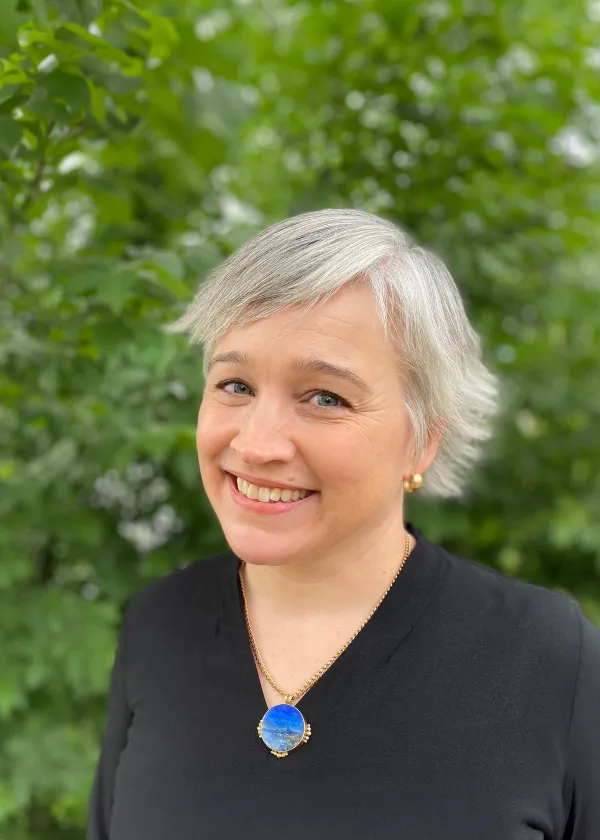
Galen McKinley is professor of earth and environmental sciences at Columbia University and the Lamont-Doherty Earth Observatory. She uses simulations and machine learning to study the ocean carbon cycle and its role in climate. As a science communicator, Galen’s goal is to highlight the ocean’s critical role in climate and, more broadly, to elucidate the myriad unseen connections between people and the environment on our limited Earth.
Galen holds a bachelor of science in Civil Engineering from Rice University and a PhD in Climate Physics and Chemistry from MIT. From 2004 to 2017, she was on the faculty at the University of Wisconsin–Madison. She teaches courses on climate and climate change, carbon cycling, atmosphere and ocean dynamics, and dynamical modeling.
Each spring, an amazing explosion of life occurs in the subpolar oceans as unicellular plants grow exponentially for a few months. Then, almost as suddenly, the phytoplankton die away because they have exhausted their critical nutrients. In a similar manner, humans have expanded their resource use exponentially over the last 200 years. Can we, the human species, avoid exhausting our environment and crashing down? Can we use our unique gift of rational thought to achieve balance on this limited Earth?
Innumerable lines of evidence show the strain on Earth’s capacity to provide energy, food, and fiber and to absorb our carbon waste—thus, we have the climate and sustainability crises. Humanity has arrived at a critical juncture where the options are to either redefine economic growth as “reducing inequality and returning to balance with nature” or to resign ourselves to increasing conflict and suffering.
The thesis that Galen will be pursuing during her fellowship at the Collegium is that, yes, we can be smarter than the phytoplankton and avoid catastrophe—but only if we learn to share within the limits of Earth. We can look to a range of promising recent trends that may herald the start of our needed transformation.
energy; food chains; climate; sustainability