Collegium Helveticum
Switzerland

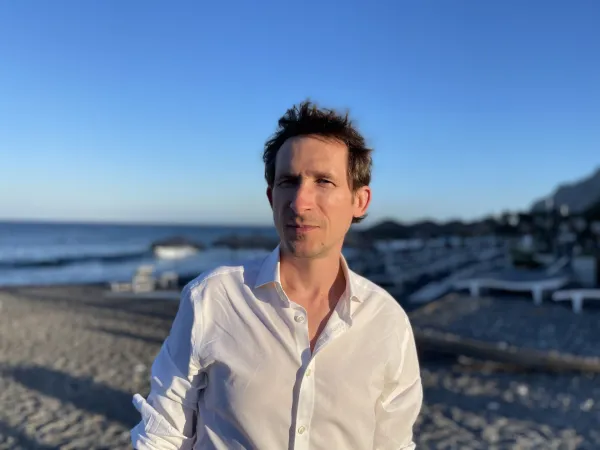
Artem Mishchenko is a condensed matter physicist at the University of Manchester (UK), studying quantum phenomena in two-dimensional (2D) materials and their layered combinations, known as van der Waals heterostructures. By assembling these ultra-thin crystals one layer at a time, his team investigates how atomic-scale interactions give rise to novel electronic, magnetic, and optical behaviors.
His laboratory combines advanced techniques—such as crystal and thin-film growth, nanofabrication, scanning probe microscopy, optical and near-field spectroscopy, and high-field magnetotransport—to generate rich experimental data. These experiments are integrated with tight-binding and density functional calculations, which, in turn, feed into machine learning models that adapt in real time. This creates a dynamic feedback loop in which artificial intelligence helps design the next experiment, while each experiment improves the AI model.
Discovering new quantum materials is still a slow process, largely because artificial intelligence (AI) lacks the kind of large, well-structured experimental datasets that have revolutionized other fields, such as structural biology.
During his fellowship, Artem Mishchenko will collaborate with others to create the first systematically curated dataset for two-dimensional quantum materials. The project will integrate automated sample fabrication, autonomous testing, and real-time data analysis to enable AI to rapidly learn which combinations of atomic layers give rise to exotic quantum states, such as superconductivity or topological order. As the dataset expands, the team will test simple guiding principles to explore how increasing both the quantity and quality of data improves predictive accuracy.
The resulting open-access resource is expected to accelerate discovery well beyond physics, with potential applications in areas like sustainable energy catalysis and quantum-secure communication. Complementing the scientific work, a public engagement program titled Quantum Futures will bring together philosophers, artists, and members of the public to reflect on how AI-driven science could shape future technologies and society.
quantum materials; artificial intelligence; machine learning; materials science; two-dimensional materials; superconductivity; topological order; automated fabrication; autonomous experimentation; real-time data analysis; open-access data; structural biology analogy; sustainable energy.