Collegium Helveticum
Switzerland

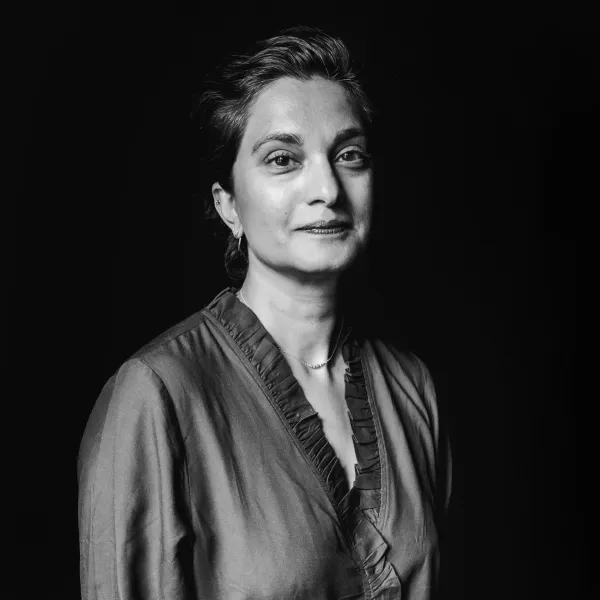
Jyoti Mistry works with film as a form of research and has produced critically acclaimed films across multiple genres; her installation work is likewise recontextualized for galleries and museums. Her most recent works include we come in peace, they said (2024), featured at Vienna Shorts; Loving in Between (2023), which premiered at the Locarno International Film Festival; and Cause of Death (2020), which premiered at the Berlinale. Her latest completed project focuses on Sámi experiences within Sweden’s colonial history.
Extending this practice into critical writing and academic leadership, her recent publications include “Three Procedures for (Un)Archiving,” Found Footage 10th Anniversary Issue (2025); “i/eye in the archive: a chance discovery of love,” Kolik Film (2024); and the special issue of Film Education Journal, “Decolonising Film Education” (2022). From 2021 to 2024, she served as editor-in-chief of PARSE (Platform for Artistic Research in Sweden), and in 2016 received the CILECT Teaching Award for innovation in film research and pedagogy. From September 2024 to September 2025, she was Leverhulme Visiting Professor at SOAS, University of London. Jyoti is also a member of the Steering Committee of CAPIm (Centre for Art and Political Imaginary), the first Swedish Centre of Excellence in Artistic Research.
The project undertaken during her fellowship has been developed through the intensive titled On the tensions of freedom: its surfaces and depths.
This research and artistic project explores how embodied urban movement, shaped by surveillance, race, gender, and migration, can be translated into a new film grammar through dance and montage.
The project focuses on producing visceral images that convey the embodied experience of moving through urban space under the constant threat of violence, whether from the state or from others, particularly in relation to gender, race, and migrant status. In collaboration with choreographer Jay Pather, these everyday movements are transposed into dance, drawing connections between the historical control of bodies under apartheid in South Africa and contemporary forms of regulation through pervasive camera surveillance.
At ZHdK, in collaboration with Annette Brütsch, the research centers on experimenting with montage as a means of developing a film grammar that bridges urban movement and choreographic expression. The project also provides an opportunity to explore motion capture techniques, complementing footage filmed in Cape Town and expanding the possibilities for translating embodied experience into cinematic form.
artistic research; film grammar; dance and choreography; montage; urban movement; surveillance; race and racism; gender; migration; embodied experience; apartheid; South Africa; postcolonial studies; motion capture; cinematic form; biopolitics; visual culture.