Collegium Helveticum
Switzerland

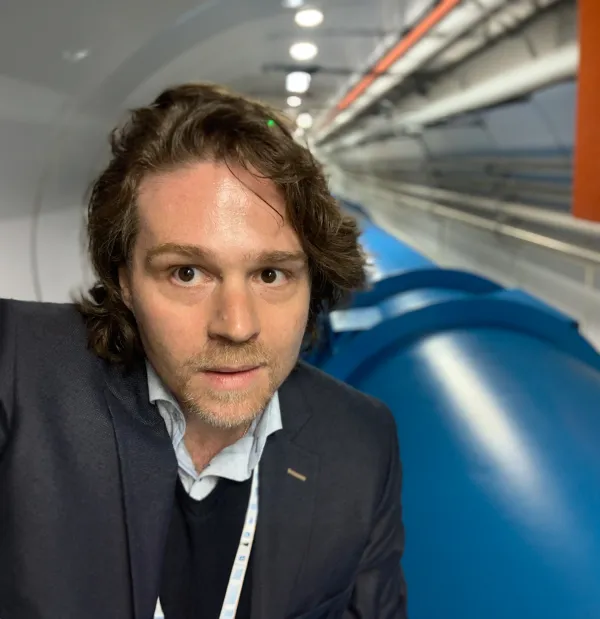
Christoforos leads the NeuroΣky research group at the University of Manchester (UK), exploring the intersection of spintronics, nanoscale physics, and neuromorphic computing. His research focuses on developing ultra-energy-efficient AI hardware by exploring the use of magnetic skyrmions—topological quasiparticles with potential applications in devices that emulate synaptic and neuronal functionalities. He is particularly interested in how nanotech-enabled computing can bridge fundamental physics with next-generation hybrid semiconductor technologies. His broader research integrates spintronics, nanomagnetism and topology, neuromorphic engineering, and nanoelectronics to push the boundaries of low-power computing. Committed to fostering academic-industry collaboration, he organized “Atoms to Bits: The AlphaBet of Intelligence,” a workshop bringing together thought leaders to explore the future of neuromorphic AI hardware.
Christoforos received his PhD in 2009 from the University of Cambridge (UK) and has previously held postdoctoral positions at the EPFL (CH), and the Paul Scherrer Institute (CH), as well as a JSPS Fellowship at the Institute for Materials Research at Tohoku University (JP)
This project explores how nanoscale spintronics-based components can be combined with ideas from neuroscience to create next-generation computing systems. Specifically, it focuses on skyrmionics nanosynapses—nanoscale devices that use magnetic skyrmions to achieve non-volatile, multi-level conductance changes. The goal is to develop energy-efficient, durable artificial synapses.
Christoforos Moutafis and his NeuroΣky team have recently made major progress in building and testing these nanoscale devices for neuromorphic applications. Working together with researchers from the Institute of Neuroinformatics (INI) at ETH Zurich and the University of Zurich, Christoforos will also study neuroscience-inspired learning models tailored to these spintronic synapses. They aim to evaluate how well these models can be integrated into practical crossbar architectures for edge AI technologies.
During his senior fellowship at the Collegium Helveticum, Christoforos will also reflect on the sustainability and societal implications of AI. By connecting physics, nanotechnology, and AI hardware, this interdisciplinary project aims to help shape the future of neuromorphic computing.
neuromorphic computing; spintronics; skyrmionics; nanotechnology; artificial synapses; neuroscience; machine learning; edge AI; energy-efficient computing; materials science.