Collegium Helveticum
Switzerland

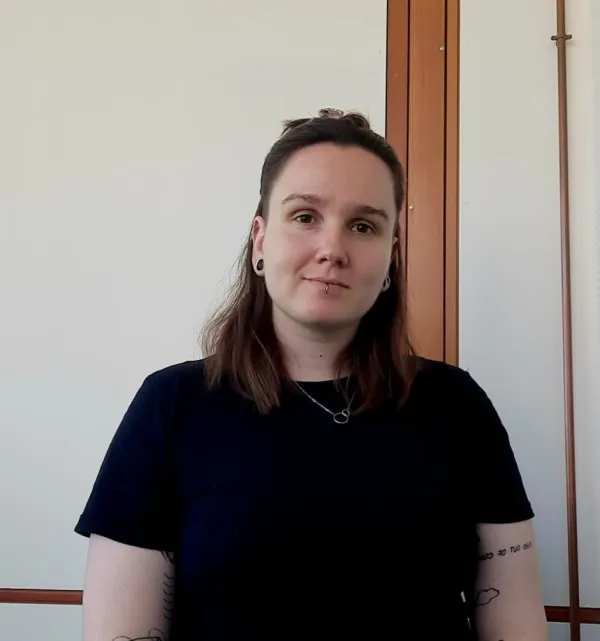
Charlotte Müller (born in 1995 and raised in Switzerland) is a chemist and a learning scientist. Her research focuses on the role of bodies in understanding imperceptible concepts. How did the way chemists interact with and exist in the world shape chemical practice historically, and how does this affect learning today? How do we relate to concepts that we cannot experience? At the Collegium Helveticum, she is interested in looking at the role of inter-domain mappings in chemistry. How do terms such as “bonding,” barrier,” or “attack” affect how we reason about chemical processes? She thereby works at the intersection of chemistry education, embodied cognition, and philosophy of chemistry.
Charlotte received her PhD from ETH Zurich in 2023, investigating learning quantum chemistry through sensorimotor experience. Prior to this, she completed a Bachelor’s degree in Chemistry and Molecular Sciences at the University of Bern (CH), followed by a Master’s degree in Computational Science at the University of Zurich (CH) and a certificate in science journalism from the MAZ, an Institute for Journalism and Communication in Switzerland.
This project aims to facilitate learning of chemical concepts by emphasizing the domain-specific language of chemistry. Expert knowledge in chemistry is largely metaphoric, with submicroscopic concepts being understood through more accessible concept. Understanding these metaphors, including what they emphasize and obscure, poses a challenge for students. For instance, when students visualize chemical bonds as sticks, they are meant to associate the structural properties of sticks with chemical bonds. However, they might also incorrectly infer that, like sticks, chemical bonds require energy to form. This project will systematically analyze the expert language used in classrooms. Based on the findings from this initial phase, interventions will be developed to support the learning of this metaphorical language.
chemistry education; domain-specific language; metaphor in science; conceptual learning; science communication; cognitive linguistics; expert knowledge; student misconceptions; classroom discourse; language and learning.