
Freiburg Institute for Advanced Studies
Germany

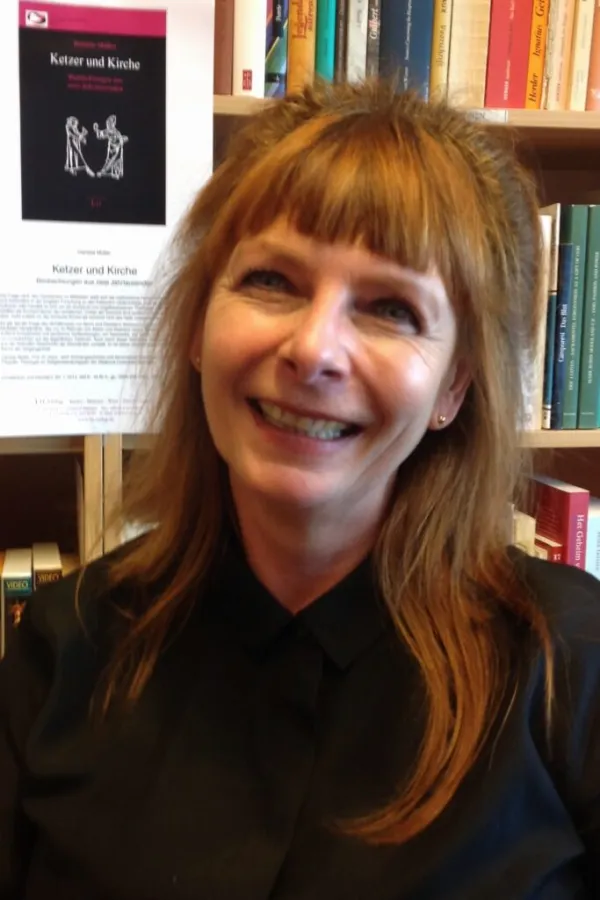
Daniela Müller studied theology, history and German literature in Würzburg, Rome and Bonn. In 1986 she received her PhD in theology, followed in 1995 by her second thesis (Habilitation). From 1985 to 2001 she was a member of the academic advisory board of the ‚Centre D’Etudes Cathares‘ in Carcassonne and from 1993 to 1996 a fellow of the DFG in Würzburg and Jena. Between 2001 and 2009 she was appointed professor of Church History in Utrecht and Tilburg. Since 2009 she is appointed professor for Church History/Canon Law and History of Christianity at Radboud University in Nijmegen/Netherlands. Since 1998 she also teaches history of canon law at the Westfälische Wilhelms-University in Münster/Germany.
In 2014 she became co-founder of the ‘Centre of Catholic Studies: historical and Systematic Perspectives’ in Nijmegen. Together with Prof. Dr. Joseph Verheyden/Leuven she is founder of the Center ‘Polemikos’. She is member of the redaction “STAR” (Brill) and of the “Revue d”histoire écclesiastique” (Brepols).
Her work focuses on the ecclesiastical discipline, particularly on the concepts of orthodoxy and heterodoxy and on the history of dissident communities.
In my research, I focus on the self-image of the Cathars of the Middle Ages and the transformations this self-defined church underwent in contrast with the Catholic Church, who considered them heretics. The exploration of the methods and techniques of polemics used in the often sharp debates among Christian medieval movements is key to my research in order to understand how religious identities and profiles in this period were defined, refined, demarcated and vilified. It is a dynamic that eventually led to new forms of profiling by both parties and to a clearer perception of one’s own religious identity.
Recent historiographical studies on Catharism has the tendency to push back on that concept as a collective description of a specific movement. I propose an alternative perspective focused on theological-historical research: In my previous publications, I have shown what new insights the study of Cathar baptism rituals can offer. It is plausible that a committed group of self-identified Cathars existed as one of their doctrines was that salvation can only be obtained solely by receiving the consolamentum, baptism by the Holy Spirit. That focus on the rite of the consolamentum was common for all Cathar groups. As adaptation to changing contexts is precisely constitutive of rites, the apparent diversity of the individual Cathar groups does not necessarily imply a fundamental difference in their collective identity as a church.
Church history; history of christianity; canon law