
Iméra - Institute for Advanced Study of Aix Marseille Université
France

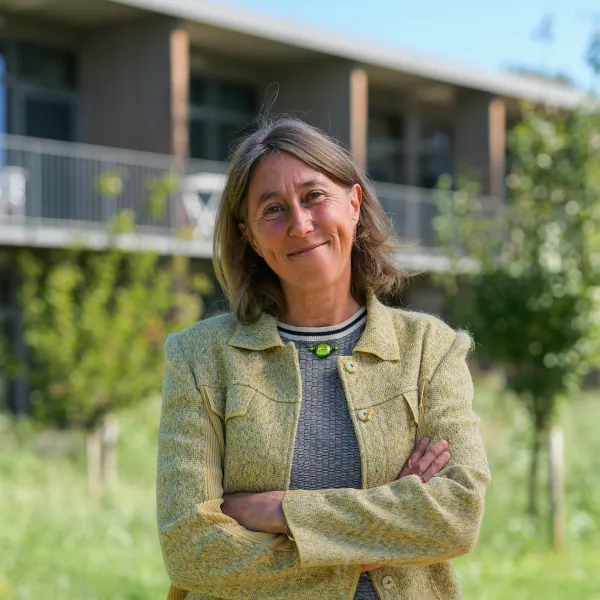
Anne Reynes-Delobel is a professor at Aix Marseille Université (amU) and a member of the Laboratoire d’Études et de Recherche sur le Monde Anglophone (LERMA UR853). Her work explores the networked circulation of the literary and artistic transatlantic modernist avant-garde in the interwar period. She is the cofounder and coordinator with Stamatina Dimakopoulou (NKUA) of the research project “Transitive Modernities” (CIVIS/LERMA). She is a founding member of the Banjo Society-Claude McKay (amU) and the current president of the Kay Boyle Society (affiliated to the American Literature Association).
Recent publications include “Un exemple de changement médiologique en acte : le ‘readie’ de Robert Carlton Brown,” Polysèmes [En ligne], 33 | 2026 ; “‘What’s inside a waiter?’ Medium and Contingency in Tender is the Night.” In: F. Scott Fitzgerald. 100 years after Gatsby, Pascale Antolin (dir.), Presses Universitaires de Bordeaux ; She has also coauthored “Passeurs de la littérature américaine en France, 1917-1967”, transatlantica 2, 2022, with B. Tadié, and Investigating Big Magazines. Journal of Modernist Periodical Studies, 11-1, 2020, with C. Cottenet & B. Tadié.
This project, which brings together literature, the visual arts, and art history, builds on the work of an international collective launched in 2021 as part of the CIVIS European Alliance. It focuses on developing a methodological tool to reexamine early 20th-century modernist literary and artistic works, emphasizing practices through a socio-historical and material approach aimed at revealing previously unrecognized connections. By placing modernist practices at the point of friction with various contexts that reflect the plurality of modernities, the goal is to view modernism as a cultural phenomenon that transcends the sociocultural and geographical spaces traditionally assigned to it, thereby bringing to light convergences and divergences through which the near and the far illuminate one another.
The hypothesis underlying this project is that literature and the visual arts—understood not only as academic disciplines but also as “everyday” practices—are inherently “transitive” insofar as they allow us to address the uniqueness of each context and, more broadly, the material, social, and political conditions in which art exists. However, situating these cultural objects within a network of often complex and sometimes contradictory relationships requires a meticulous and nuanced analysis of the actors, factors, and effects involved, which renews our focus on the literary and artistic field as a space of power and on the creative act as a production of affects, figures, and symbols. The innovative use of the term “transitivity” — inspired by its grammatical roots— aligns with the project’s central aim of paying closer attention to the multiplicity of actors and the interdependent relationships that come into play in cultural practices.
Literature; Visual Arts; Art History