
Collegium Helveticum
Switzerland

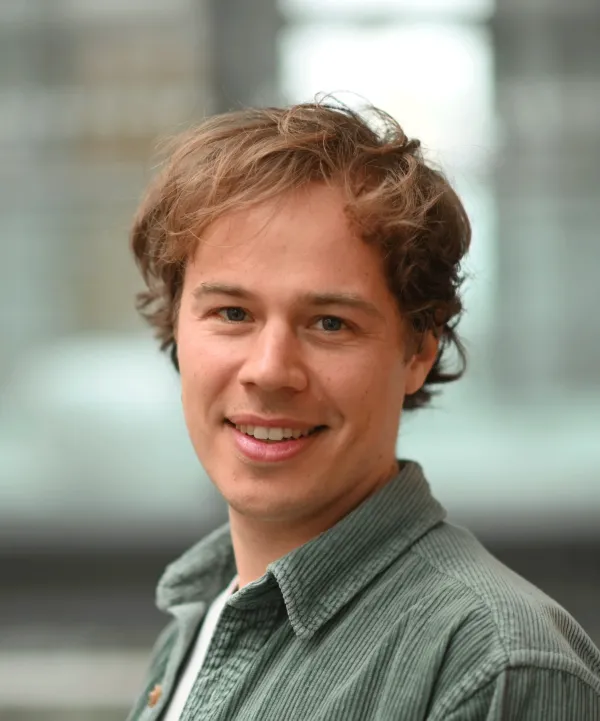
Benjamin Schiffer (born 1994 in Germany) is a theoretical physicist working at the intersection of quantum computing, many-body physics, and machine learning. He is fascinated by the idea of using quantum computers as scientific instruments at the frontier of what we can learn about nature at its extremes–the smallest and coldest scales, which are the territory of quantum phenomena. Benjamin has been especially interested in hybrid approaches that combine machine learning with quantum computing, as well as in bridging theoretical ideas to real experiments.
Benjamin received his PhD in 2026 from the Technical University of Munich (DE), for his doctoral research at the Max Planck Institute of Quantum Optics in the group of Ignacio Cirac. Before turning to theory, he gained hands-on experience in an experimental quantum optics lab. Alongside physics, he holds a Bachelor's degree in philosophy, where he studied the ethics of humans interacting with intelligent machines. He remains curious about questions beyond his own field and enjoys sharing (quantum) science with the public.
One hundred years after Schrödinger wrote down his famous equation, we cannot generally solve it to compute what it predicts for quantum materials. This is because simulating many interacting quantum particles quickly overwhelms even the largest supercomputers. Quantum computers promise a way forward, pushing beyond what is accessible with classical computers.
To understand new forms of quantum matter, some of the most valuable outputs of quantum computers are the characteristic energies at which a quantum system responds. However, these quantities are also among the hardest to obtain.
In this project, Benjamin Schiffer will develop new methods to make these spectral fingerprints—the characteristic energies described above—accessible on the quantum computers becoming available today.
He combines state-of-the-art quantum algorithms with machine learning approaches to understand elusive new forms of quantum matter. Benjamin sees this as a step toward using quantum computers as powerful scientific instruments for exploring the natural world. He will also engage across scientific disciplines on the broader societal implications of emerging quantum technologies.
quantum materials; quantum computers; characteristic energies; spectral fingerprints