
Freiburg Institute for Advanced Studies
Germany

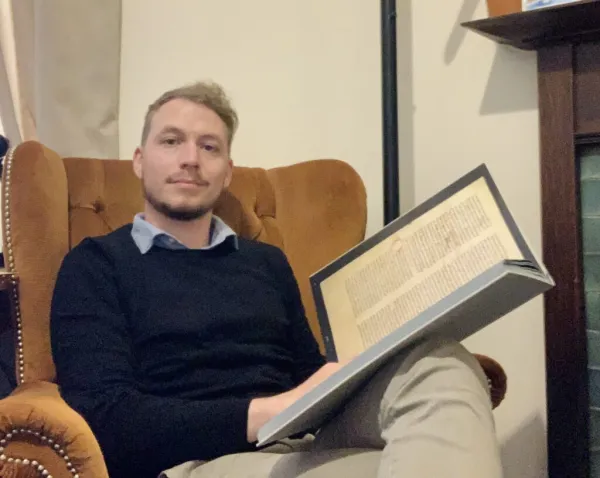
Linus Ubl finished his B.A. in German and History at the Catholic University of Eichstätt (2014), followed by an M.St. in Modern Languages (2015). Afterwards, he returned to Eichstätt to finish both his M.A. and a teaching diploma (‘Bayerisches Staatsexamen’) in German and History (2016). Ubl’s D.Phil., completed again at Oxford (2019), was funded by the AHRC and the Cusanuswerk, and he stayed on as a Departmental Lecturer as well as Tutor for German at Somerville College. Since January 2023, he has been a postdoctoral fellow at the Martin Buber Society of Fellows in Jerusalem.
In my project, I am seeking to link different historical, theological, linguistic, legal and literary statements dealing with suicide. The interplay of both traditional and subversive discourses in medieval culture, thus the assumption, are represented in literary productions, and vice versa literary texts played a significant part in stimulating those negotiations. Case studies will be analysed in a variety of genres (e.g. Kaiserchronik, Courtly narratives, Minnesang, Mysticism). It will assess how the different perspectives discursively influence and productively interact with each other. One question among others will be whether – and to what extent – literary texts reflect their aesthetic potential as specifically poetic texts, and are thus able to transcend other discourses.
Coming from studying German and History very broadly, I am generally interested in any kind of intertwining between both disciplines, particularly in the Middle Ages. This includes historiography, the history of Christianity, cultural history as well as palaeography, but also reception studies and the question of how history is told in the present, i.e. books, movies and popular culture.
Manuscript studies; Reception studies; Cultural history; Church history