
Constructive Advanced Thinking (CAT)
project
Over Their Dead Bodies: Underlying axioms and contemporary use and handling of human remains from institutional collections




-
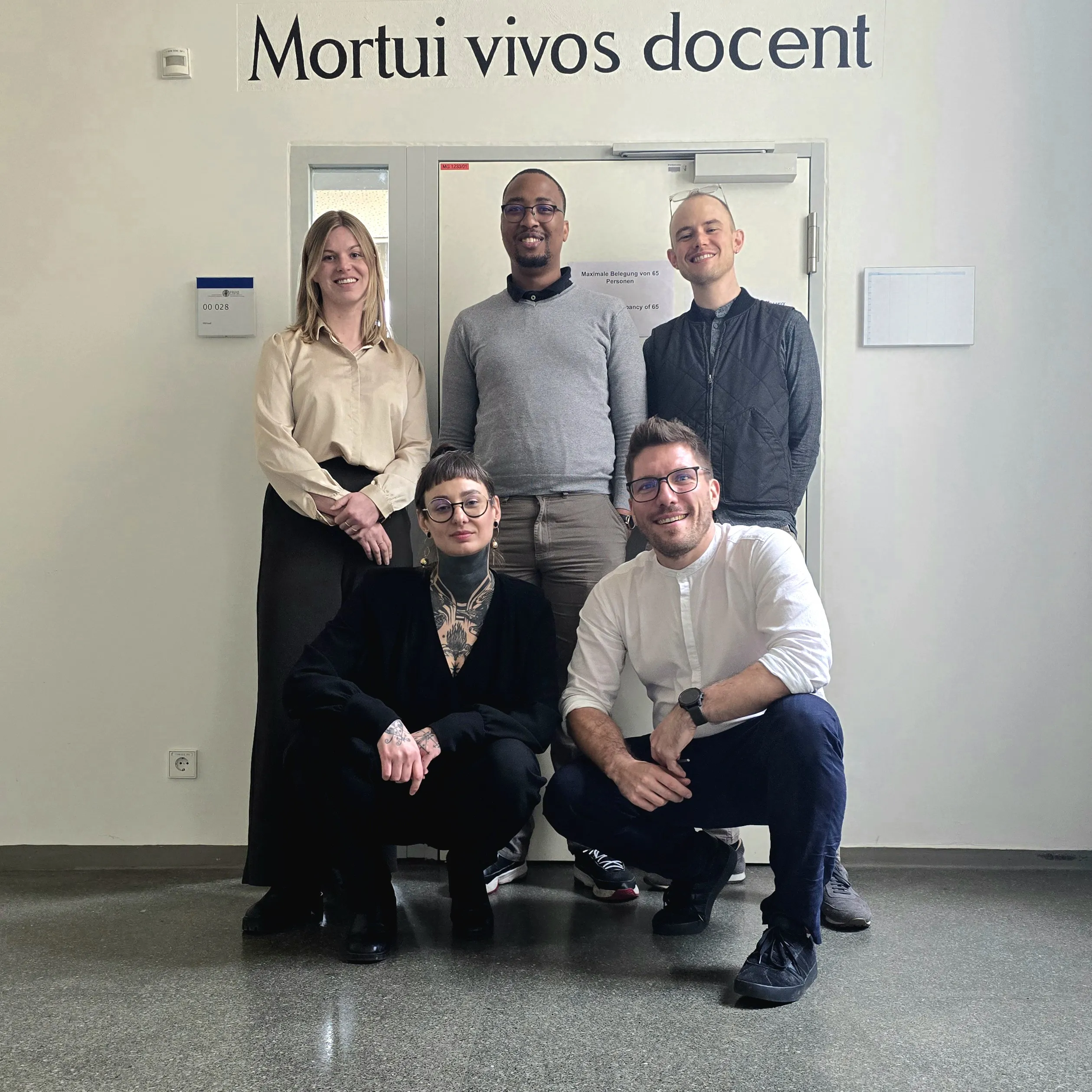
Jonatan Kurzwelly (Peace Research Institute Frankfurt, Germany)
Joanna Karolina Malinowska (Philosophy of Science, Adam Mickiewicz University, Poland)
Phila Msimang (Stellenbosch University, South Africa)
Malin Wilckens (Leibniz Institute for European History in Mainz, Germany)
Paul Wolff Mitchell (University of Amsterdam, The Netherlands).
Historically human remains, and skulls in particular, have been repeatedly used to construct arguments justifying racialization and racism, confining people to fixed notions of identities and legitimising violent systems of exploitation and oppression. The hundreds of thousands of human remains amassed in numerous ‘collections’ across the world constitute an ethical and political challenge of reckoning with the violent past, its legacies and continuities. One central concern of contemporary practice is the examination of histories of the amassed mortal remains (i.e. provenance research) and their repatriation. In most cases there is, however, limited or no biographical information available about concrete remains and the individuals they belonged to, presenting a challenge of the basis upon which repatriations take place. Historical and biological research methodologies provide the basis upon which human remains are ascribed as belonging to a particular identity group, and returned to contemporary representatives of that group. This process is riddled with ethical, conceptual, methodological and political issues that necessitate trans-disciplinary scholarly attention. Some of the key issues which this group, in collaboration with different stakeholders, critically examines include: reliance on scholarly and folk ethno-racial classifications in bio- anthropological ‘ancestry estimations’; conflation of biological population categories with socio-cultural identities; ascription of socio-cultural group belonging based on scarce historical information; reproduction of racialized ethnic and national categories in political practice; and the ethics of continuous storage and handling of remains. The group analyses these problems with particular emphasis on regional contexts, such as Southern Africa and Eastern Europe, exploring the differences as well as discussing the biases that exist in differential treatment of remains depending on their origin. This project aims to generate contributions for both scholarly debates, as well as provide a reliable basis for future practice and collaboration between diverse stakeholders.