
Hanse-Wissenschaftskolleg
Germany

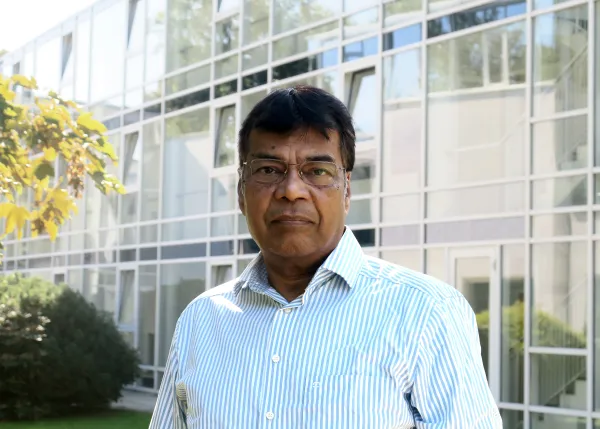
Professor Bhattacharyya is a Professor ( HAG) of Mathematics at the Indian Institute of Technology Kharagpur, India, and a distinguished researcher in computational mathematics, electrokinetic transport, microfluidics, and nanofluidics. He obtained his PhD in Computational Fluid Dynamics from the Indian Institute of Science, Bangalore, India, and subsequently carried out postdoctoral research at the University of Leeds and University College London, UK, as well as Ohio State University, USA.
Prof. Bhattacharyya is widely recognized for his pioneering contributions to the theoretical and computational understanding of electrokinetic transport phenomena in microfluidic and nanofluidic systems. A significant feature of his research is its ability to bridge fundamental theoretical models with experimentally observed phenomena. These models have provided deeper insight into a range of experimentally observed phenomena and have also demonstrated strong connections with characteristics revealed through molecular dynamics simulations. Another major area of his research is the development of advanced numerical algorithms for solving nonlinear PDEs.
He has received several prestigious fellowships and recognitions, including fellowships from the Max Planck Society, Germany, and the Engineering and Physical Sciences Research Council, UK. He is an elected Fellow of the National Academy of Sciences, India, and Institute Chair Professor at IIT Kharagpur.
The search for new materials – electrocatalysts - that should allow us to access cheap and reliable energy and to enable decarbonization of our economy requires advanced chemical techniques that allow investigating chemical processes with high magnification. In this project we aim to provide a guide on bringing a chemical microscopy technique – tip-enhanced Raman
spectroscopy (TERS) – to work in real world environments. The biggest challenge so far for this advanced tool was related to stability of a scanning tip, which is both difficult to produce and is also rather unstable in liquids. To overcome this issue we are employing a novel approach of trapping a small nanoscale particle at a tip of a mobile nanopore, an approach that should replace a traditional way of making these probes. Modern chemistry is very flexible to produce such particles in large numbers, they are stable and provide all necessary optical and chemical properties. The major difficulty is to catch this particle and reliably attach it to a nanoscale tip. To “fish” these particles we will employ electroosmosis, a peculiar phenomenon that occurs due to the movement of ions dissolved in liquid, which causes a fluid flow. In this project we will develop a theoretical model that describes this phenomenon in high detail. Based on numerical simulations of the set of partial differential equations governing these phenomena, we will determine the parameters for manipulating the flow and trapping the nanoparticles.
Microfluidics; Ion transport; Modelling