
Hanse-Wissenschaftskolleg
Germany

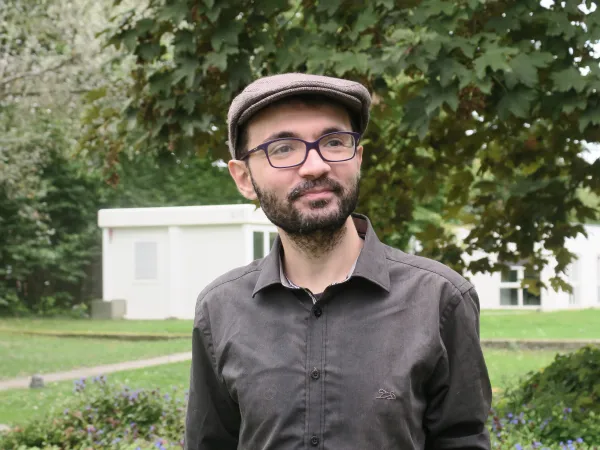
Rogério Augusto Capobianco is a theoretical physicist whose research focuses on gravity and its effects on particles, light, and fields. He obtained his PhD in Physics from the University of São Paulo (USP), Brazil, where he studied the effects of gravity on test particles and fields in different gravitational settings.
His research explores how gravity shapes the environment around compact objects, such as black holes, and the imprints it leaves on particles, light, and other physical processes. He is particularly interested in situations where black holes are not isolated, but interact with more complex gravitational, electromagnetic, or rotating backgrounds, going beyond the Kerr paradigm. To investigate these systems, he combines exact solutions of Einstein’s equations with analytical and numerical methods, studying phenomena such as particle motion, black-hole shadows, and other observable signatures of strong gravitational fields.
More recently, his work has focused on so-called swirling spacetimes, in which black holes and other gravitational systems are immersed in a rotating background. These studies aim to understand better how different gravitational environments influence observable effects and what they can reveal about the nature of gravity.
Black holes are among the most fascinating objects in our universe. These objects are typically studied as isolated objects. Still, in more realistic scenarios, black holes often exist in much more complex environments, like surrounded by accreting matter, in binary systems, or even immersed in external gravitational and electromagnetic fields. This project explores how external factors influence the behaviour of black holes and the motion of particles around them. We focus on recently discovered solutions of Einstein’s field equations, which combine rotation and electromagnetic fields. One of them also includes the cosmological constant, while the other represents a black hole immersed in an electromagnetized-rotating background. We focus on the description of particle motion in these two solutions. The study of particle motions is keen to understand the geometrical properties of a spacetime, such as the curvature, horizon geometry, and the shape of the black hole shadow. These structures are essential to interpreting the current and future observations and for testing general relativity in the strong field regime.
Gravity; General Relativity; Nonlinear Gravitational Phenomena; Black Holes; Black Hole Shadows; Strong-Field Gravity; Particle and Photon Dynamics