
Hanse-Wissenschaftskolleg
Germany

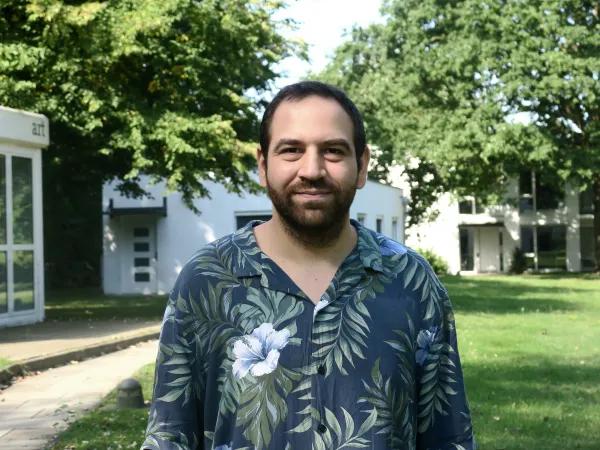
Nico Lombardi is a mathematician working in convex geometry and the analytic aspects of convexity. He received his Ph.D. in Mathematics from the University of Florence, Italy, in 2019, with a thesis on valuation theory for quasi-concave functions. He subsequently held postdoctoral positions at the University of Florence, the University of Bremen, Germany, and TU Wien, Austria, where he worked on a variety of problems in convexity.
His current research interests include Cheeger sets and inequalities related to the 𝐿_𝑝 Brunn–Minkowski theory. He is also interested in problems at the interface of convex geometry and other areas of mathematics, in particular matrix analysis and mathematical economics. His broader research interests concern analytic and functional approaches to problems arising in convex geometry.
Lombardi has taught mathematics in Italian, English, and German, including Master’s-level courses in mathematics and Calculus and Linear Algebra courses for engineering students.
The general research framework for the application to the "Regular Fellowship" at the Hanse- Wissenschaftskolleg, Institute for Advanced Study explores an important question in geometry, focusing on how the volume of certain shapes, known as convex bodies, behaves under specific conditions. Convex bodies are geometric shapes, like spheres or cubes, that cannot have holes or indentations. The main research topic of this application is to better understand how the volume of these shapes changes when they are combined in particular ways, with an additional focus on how they project onto a flat surface, called hyperplanes. More specifically, the research examines what happens when two convex bodies have the same projection onto a hyperplane. The aim is to find out how the interaction and combination of these convex bodies behave under the projection constraint, revealing new geometric properties that could be useful in areas ranging from mathematics to computer science and beyond.
Convex Geometry; Brunn–Minkowski Theory; Cheeger Sets; Matrix Analysis; Mathematical Economics