
Hanse-Wissenschaftskolleg
Germany

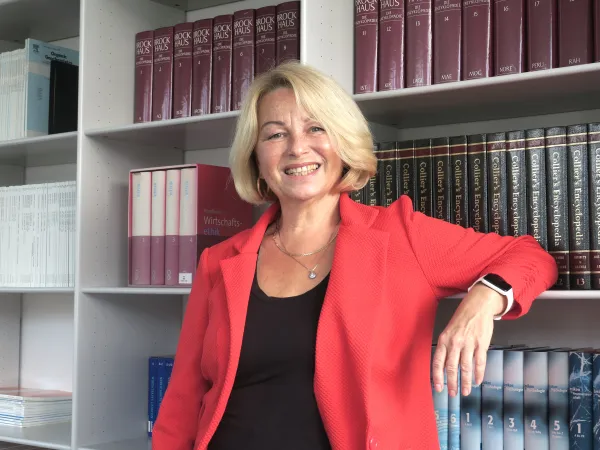
Olena Mykhailenko works at the frontier where artificial intelligence reshapes culture, economies, and the conditions of social continuity. Her research challenges dominant narratives of AI as a productivity tool, exploring how it becomes infrastructure for maintaining work, meaning, and cultural life under pressure. Drawing on economics, sociology, and cultural studies, she develops conceptual frameworks for understanding adaptation to AI where stability cannot be assumed.
Her experience as a university professor and government advisor in Ukraine, alongside research in Canada, Germany, and Latvia, informs her exploration of relationships among socio-economic development, cultural values, digital transformation, and social psychology across different settings.
At Goethe-Institut Ukraine and House of Europe, Olena designs programmes supporting learning, professional and creative exchange between Ukrainian educators and cultural professionals and colleagues in the EU and UK.
Since the full-scale invasion, Ukrainian university educators have faced power outages, displacement, missile strikes, and relentless uncertainty. Despite this, they continue teaching, researching, and supporting students. But their daily routines have collapsed, making it hard to focus, plan, or feel any sense of normal life. At the same time, large language models (like ChatGPT) are becoming widely available and easy to use. These tools never get tired, don’t experience disruption, and can help hold ideas in place—something many educators are finding useful during the chaos of war. This project explores how Ukrainian educators are using these tools not just for tasks, but to support their thinking and structure their professional lives. The project will begin with a focus group and the researcher’s own activity logs to build a model of how these tools are being used. Then, two or three more group discussions and a review of educators’ interaction histories will help build a clearer picture of how people are adapting in practice. The results will be shared through a published article and a new discussion network for educators interested in using AI to support each other and stay grounded during difficult times.
AI; Human–AI collaboration; continuity infrastructure; crisis; war; Ukraine; digital survivance